An Honest Look at a Property’s Deferred Maintenance
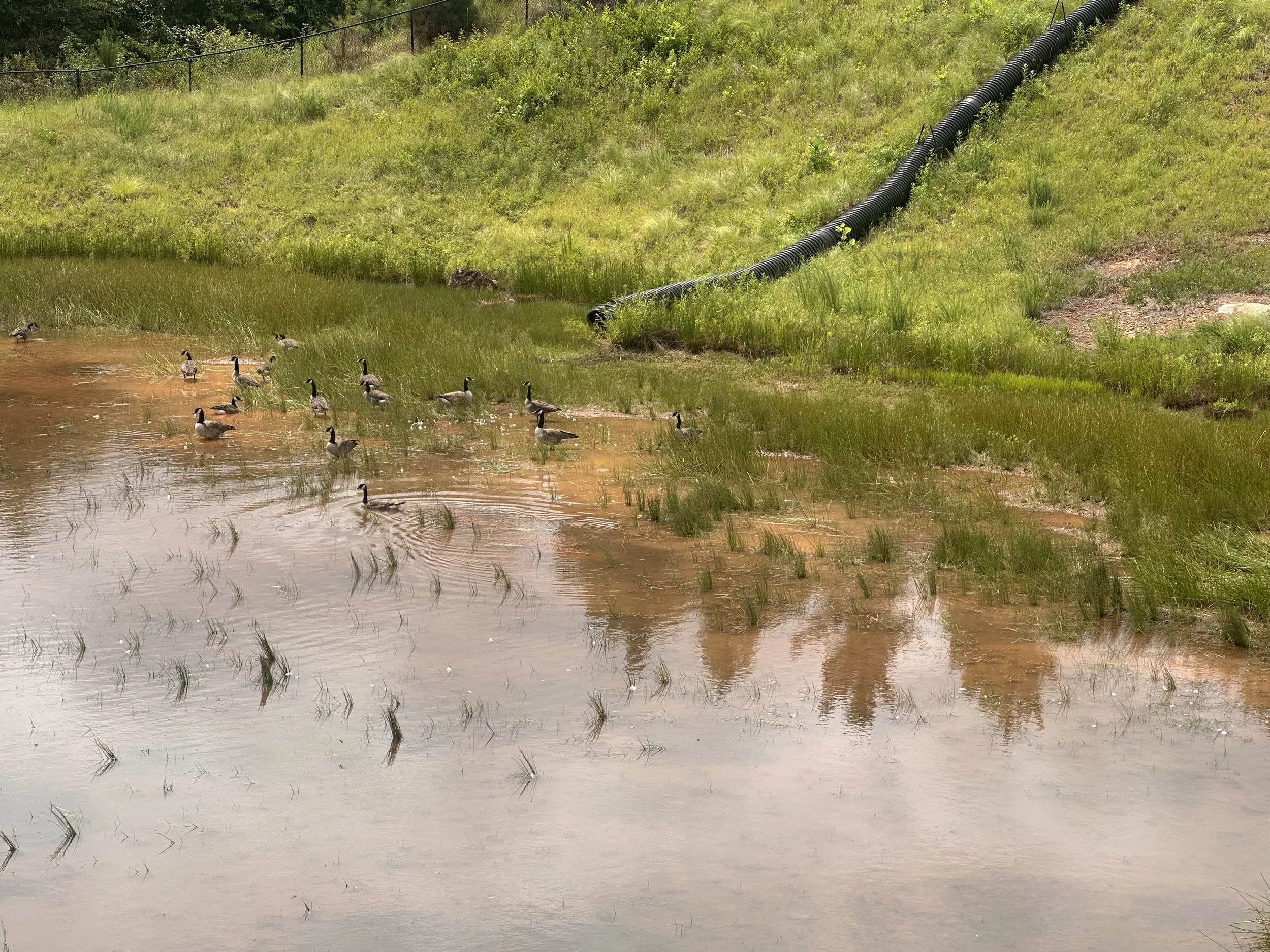
A property manager walks the property 72 hours after a hard rain. The problem hasn’t changed. The same problems that were glaring after the last rain event. The detention pond is holding water it shouldn't, the outfall pipe has a crack that was on last year's list, and there's sediment built up around an inlet that was supposed to be cleared out months ago. All three problems might be getting worse, nobody really knows. Somewhere between the last inspection and now, they became problems to deal with later.
That's the weight of deferred maintenance. It's not a single failure, it's a slow accumulation of small delays that eventually show up as flooding a tenant's loading dock, a violation notice from the regulator, or a call from ownership asking why a known issue turned into an emergency repair. By the time it's visible, it's already expensive, and reputations tarnished.
If only a property manager could manage stormwater assets like the rest of the property, where every asset has a condition score, a named owner, a repair date, and a line in the budget. Picture that same walk under that reality. The detention pond drawing down the way it's supposed to, because the landscape vendor tweaked their vegetation process. Removing aediment at the inlet pipe cleaned once ownership assigned. And pricing for filters in hand to slow down future sediment deposit. Not an open question. Not a line carried over from last quarter. When ownership asks about the property, they see a quick glance score of stormwater management, what's scheduled and what it costs, and the conversation is over in five minutes.
The Real Problem Isn't the List, It's the Priority
Every property has a maintenance list. What most properties don't have is a clear sense of which items on that list are actually risks and which are just tasks. When everything looks equally urgent, nothing gets acted on. Deferred maintenance is rarely a sign that people don't care. It's a sign that the real risks were never separated from the noise.
In the Board Room, "Deferred" Often Means "Undecided"
Call it what it is. Deferred maintenance is often the board room term for “We don't know what to do.” Ownership hears "deferred" and assumes it's a budget decision. Most of the time, it's actually a knowledge gap. However, it’s just a matter of time before the house of cards tumbles and ownership figures it out. Nobody has scored the risk, priced the fix, or built the case for acting now instead of later. Calling it deferred seems easier than admitting there's no plan. But that’s playing the short game
Nothing Gets Fixed Until Someone Owns It
A risk without an owner doesn't get resolved. It gets discussed, noted, and carried forward, meeting after meeting. Deferred maintenance often has less to do with money than with the fact that no single person was ever assigned to track a corrective action through to completion. Without ownership, even a fully funded fix sits unresolved.
A Number Ownership Can Plan Around
Deferred maintenance requires a CapEx budget. Not a rough estimate mentioned in passing, an actual number tied to an actual timeline. Ownership can plan around a budget. They can't plan around a vague sense that something should probably get done eventually.
A Plan Is What Makes Deferral Defensible
Deferring a repair isn't automatically the wrong call. Sometimes it's the right one. But deferred maintenance only works when there's a real plan to manage the risk in the meantime, not just a decision to wait and hope. Without that plan, deferral is just risk left unmanaged with a more comfortable name.
Where Buck HydroLogics Fits
This is the same work you're already responsible for. Buck HydroLogics doesn't add a task, it gives the existing one structure. That detention pond, that cracked outfall, that clogged inlet, instead of living in your memory and a stack of old inspection notes, each one gets a risk score, a named owner, a due date, and a dollar figure attached to it in one system. It scores your stormwater system across six categories, so priorities are based on actual risk, not guesswork. It assigns and tracks corrective actions, so nothing quietly rolls forward unowned. And it ties every open item to a CapEx budget, so when something is deferred, it's a documented decision with a plan behind it, not a gap waiting to be discovered later.
You already know the property. Buck HydroLogics makes sure everyone else, ownership, tenants, and regulators, sees the same clear picture you do.
It’s time to manage the property’s StormWater assets with the long game in mind. Property managers can have confidence that tenants are protected, investor’s ROI is maximized, regulators are satisfied. If that confidence helps you with ownership groups contact Buck HydroLogics today.
Uncover Hidden Risks, Gain Confidence

Every property manager knows that feeling when a storm hits, a drain backs up, a tenant is already furious, and suddenly you're explaining to ownership why nobody saw it coming. That's not a management failure. It's a visibility failure.
Here's the truth, you're not properly managing the property if you can only react to problems. Reacting means the risk already turned into a cost, a violation, or a call you didn't want to make. Managing means you saw it early, had a plan, and controlled the outcome.
Reacting vs. Managing Stormwater Assets
Reacting looks like a failed inspection, an emergency repair, a frantic tenant, a frustrated regulator, and an owner asking questions you can't answer.
Managing looks like knowing your stormwater system's condition before anyone else has to point it out, having corrective actions already scheduled, and walking into every conversation with ownership, tenants, or regulators already ahead of the issue.
That shift, from reacting to managing, is what confidence is built on.
A 30-Second Glance Changes Everything
You don't have time to dig through old reports, and PDFs every time someone asks about the property's stormwater condition. You need an answer now, and it needs to be right.
That's the whole point of Buck HydroLogics, a stormwater assessment system that scores your property across six categories, tracks every corrective action, and stores your photos and documents in one place, giving you a live view of where things stand. Ownership, regulators, and you are all looking at the same accurate picture, in seconds instead of hours.
Stormwater Asset Management Isn't One More Task on Your Plate
Property managers already juggle enough. Buck HydroLogics isn't a new responsibility. It's a better way to fulfill the stormwater responsibilities you already carry. The assessments, the recordkeeping, the compliance documentation, that work exists either way. This just makes it visible, organized, and easy to hand off in a conversation instead of a scramble.
And you don't have to build or run any of it yourself. We do the work, the full assessment, the scoring, the documentation, so what lands in your hands is a clear, ready to use picture of the property.
What Buck HydroLogics Means for Your Next Ownership Meeting
You know the moment. Ownership asks how the property's doing, and you're stuck choosing between a vague reassurance and a list of things that went wrong.
How much value do you give ownership when you discuss risks over problems, prove the corrective actions are being tracked, and show them a CapEx budget? That's the difference between managing the property and just working there.
The next time you have an ownership meeting, approach it with confidence, not because you hope it goes well, but because you already know what they're going to ask. Buck HydroLogics hands you the score, the tracked corrective actions, and the budget before you walk in the door, so instead of explaining the problem, you're the one who solved it.
Asset Confidence Is a System, Not a Feeling
Confidence in these conversations doesn't come from experience alone. It comes from having the right information at the right moment. Buck HydroLogics gives you that: a clear score, a tracked plan, and a budget you can defend, all visible in the time it takes to glance at a screen.
You already do the work of managing stormwater risk. Now you can prove it, to ownership, to regulators, and to yourself.
What Property Managers Need to Know About Stormwater Inspections
WHAT IS A STORMWATER INSPECTION :
Understand that fulfilling local, state, and federal inspection requirements is not the same as property management. The regulatory inspections answers one question, is the infrastructure currently working as designed. I once sat in a class with a mix of regulators and consultants from around South Carolina. The facilitator showed an image of a stormwater pond. He said raise your hand if you think this pond is deficient. As some of the hands went up, mine included, the facilitator gave a satisfying grin and said, “That provided my point better than I thought.” He pointed out those who were not satisfied with the pond’s condition were all consultants. He turned to the seasoned regulator and asked, “Why would you pass this pond?”
The veteran, government regulator simply said, “It’s functioning, today.” The consultants argued that deferred maintenance would be costly to the property owner and that failure was imminent. The facilitator came to the regulator’s support explaining that inspections only ask if the stormwater infrastructure is functioning at the time of the inspection. None of the regulators in the room were interested in the risks.

So what is an inspection? Historically, it merely evaluates the current functionality and environmental effect. The inspection does not worry about the CapEx budget and increasing cost of corrective action. To rely on regulatory inspections for decisions on stormwater infrastructure is to wait for problems to surface. The inspections do not evaluate risks and provide effective oversight for property managers.
WHO IS RESPONSIBLE FOR THE INSPECTIONS:
Regardless, the inspections must take place. South Carolina requires property owners to conduct annual inspections in the Stormwater Maintenance Agreement. These annual inspections can be completed with solely compliance in mind, which seems to be a wasted opportunity. However, when meeting this obligation, the property manager fulfills his role with an asset assessment. An in depth assessment goes beyond the current conditions. It provides CapEx data, corrective action tracking, and an overall health score for the facility.
While the inspection should be performed by a stormwater professional who is willing to assist with uncovering hidden risks, it is the property owner’s ultimate responsibility for having an inspection completed each year.
What about inspections from the state or county.
True, local and state regulators will conduct inspections. These generally take place once every five years, or so. However, during these audits, the regulator will often ask to see your inspections over the past several years. Even if your pond is functioning, the auditor will note any document gaps as a deficiency.
DOCUMENTS TO KEEP ON HAND:
There should be documentation of each inspection complete with time stamped photos. The old school method of tracking this documents is a three ring binder. However, many scenarios are wanting an electronic file or database. Especially when stored online, the regulator is able to look at these documents without stepping foot on your property.
Here is a list of items to keep in the file:
Records from all inspections with photo documentation: The photos defend the report and are to be geo & time stamped. Most regulators want to see at least three photos. We recommend focusing on the outfall, wide angle of the entire stormwater pond, vegetated swales, and catch basins.
As-Built plans: Do not assume that your local development office has these on hand. You should have a copy accessible as a benchmark for the inspections and these are required to have for most repairs to be completed on stormwater infrastructure.
Stormwater Pollutant Prevention Plan: Industrial sites are required to have these on hand as an operational document specifically written for the facility. However, we recommend a similar document on all commercial and multi-family residential sites. We refer to these documents often as a Sustainability Plan or Environmental Stewardship Committment.
Corrective Action Tracking: Though regulators are primarily concerned with current condition, to be able to show that you act in a timely manner to problems, often gives regulators the confidence that your property is being managed.
Learn more about Buck HydroLogics Management System for documentation storage.
WHEN SHOULD INSPECTIONS BE PERFORMED
Inspection rhythm by a stormwater professional is really site specific. We recommend that industrial sites should be randomly inspected once a quarter. This allows to track trends and build stronger confidence that the property is right for the tenants and that the tenants are good stewards of the property. Commercial property (offices, retail, and residential) can get by with two assessments per year. Beyond this, we recommend that property managers and facility managers make a visual after every major rain event. Have a checklist of 5 or 6 things to note as you perform a quick walk through. Your stormwater professional should be able to provide you with a list that is site specific.
TOP 3 VIOLATIONS WE SEE MOST OFTEN
Vegetation is at the heart of most violations. Overgrown vegetation and lack of density. One area that is often forgotten about when mown is the pipe between the discharge riser and outfall. Remember, the outfall is where the stormwater and potential pollutions leave your site and enter the watershed. If a regulator cannot get to the outfall pipe he cannot inspect your effect on the environment and is left to assume that you are not overseeing the effects.
Documentation gaps is another deficiency. Too often a site assumes that they do not have to record the activities on their property. They also do not know what needs to be documented. Regulators must see documents to defend the health of the stormwater. This same defensible documentation is used to protect property owners in legal disputes.
Failure to protect catch basins with the proper filter. There are several types of filters that can be inserted into stormwater catch basins. When protecting basins from floatables inside green infrastructure is different from using a filter in a parking lot that absorbs fuels and oil. Too often these filters are left alone or cut when full.
HOW PROACTIVE INSPECTIONS SAVE MONEY LONG TERM
As you consider inspections, you will fall short if you see them as a simple fulfillment of regulations. Inspections should be used to catch problems. As we interact with our clients, we initially give a pass or fail based on the functionality of the stormwater pond. However, we continue to the next level of helping the client prioritize restoration needs and budget for those repairs. Many of the repairs we can provide ourselves, but often we lead through the finding quotes and overseeing the project for the client.
Stay ahead of stormwater issues. We share practical stormwater insights, inspection reminders, and compliance tips written specifically for property managers. Join our mailing list to stay informed and reduce risk before problems arise.
If you’re a property manager responsible for stormwater compliance, Buck Outdoors LLC provides inspections and maintenance for residential, commercial, and industrial properties across the upstate of South Carolina. Feel free to contact us if you have questions about your site in Oconee, Pickens, Anderson, Greenville, Spartanburg, Cherokee, Laurens, or Greenwood counties.KEYWORDS: stormwater inspections for property managers, stormwater compliance, commercial stormwater inspections
SWPPP Inspections Explained: A Practical Guide for Property Managers
SWPPP, pronounced SWIP, is a term that many environmental professionals use. We say SWPPP because it’s fun to say, and because it’s a lot quicker than saying, “StormWater Pollutant Prevention Plan.” The 300 page three-ring binder that is generally found on a book shelf of the EHS director’s office and can be too often forgotten. However, the document is to be updated with changes on the site and inspection reports.
WHEN SWPPP INSPECTIONS ARE REQUIRED
Industrial sites are divided into sectors. Each sector provides different expectations for what is to be included in the SWPPP. However, all sectors are required to give four inspections, one of which should be completed during a rain event that creates discharge. These quarterly inspections are to be completed, documented, and placed in the three-ring binder. They should also be accompanied by at least three photos. I tell my inspectors that we are not on site to solely look for problems.
WHAT INSPECTORS LOOK FOR
Inspectors record what functions as design, what areas need to be monitored as a concern, what repairs or changes should be made, and what is currently failing. The inspector, then is a sword and shield. Defending the property and practices as well and going on the offense with strategic capital improvements.
An inspector’s visit can be simplified through color code.
Gray: He is assesses the structures on site. These structures begin with the outfall pipe, which is connected to the discharge riser in the stormwater basin. Through these two structures, a lot can be told about the site. Sediment accumulation, trash, odor, algea all point to various issues throughout the property. The inspector also looks at riparian buffers, inlet pipes, impervious surfaces, catchbasin, junction boxes, flumes, curbing, downspout tie ins, and other man made BMPs on the site.
Green: These are are often considered low impact development (LID), which includes rain gardens, vegetated swales. the lawn, as well as slopes and hillsides. The inspector is looking for erosion and sediment accumulation. The vegetation density is required to be over 80% throughout the entire site. An inspector may considers plant health. Also around under ground infrastructure, the inspector is looking for divets or other signs of sub-surface soil loss.
Brown: Furthermore, the inspector considers the soil. Is the soil saturated pointing to insignificant water conveyance? Has there been improper soil compaction on site from heavy equipment? Again, looking for sediment accumulation, and erosion. Does the soil have a septic, sweet, or foul odor?
Blue: Finally, the inspector consider water. Lookin for water standing where is should be gone (72 hours after a rain event), looking for oil sheen, or other pollutants in the water. If a body of water is near by, the inspector will look for fish kill. While the inspector may be able to notice extreme turbidity, most water contamination requires sondes. There is increasing pressure for some industrial sites to install electronic monitoring devices. If your site does not currently have them, it might be worth starting those conversations now. Buck Outdoors helps industrial sites throughout the United State design, calibrate, instal and manage monitoring devices.
DOCUMENTATION PROPERTY MANAGERS MUST KEEP

Your SWPPP is a living record. It should be growing each year. In your three-ring binder you should be adding the following documents:
Spill Reports: The SWPPP has a template that should be completed to document what caused the spill, what was spilt, and how the spill was contained and disposed of. You will also document any procedure changes that illuminate the risk.
Inspection Reports: Each quarter, you need to add your inspection report. These should be performed, dated, and signed by a stormwater professional. If your inspector does not include photos, ask for a minimum of three defensible photos (geo & time stamped) from the inspection.
Construction Change: Changes to your facility should be included in your SWPPP. Often time, these changes will require a more indepth edit to your SWPPP. For instance a new building or parking lot will require such an edit.
HOW OUTSOURCING SWPPP INSPECTION REDUCES STRESS
The EPA, or your state, requires that a stormwater professional inspect quarterly. By bringing in a third-party inspector, there is a person on site who has not grown accustomed to the faculty’s condition. A fresh set of eyes, tends to give a more in depth and comprehensive evaluation. However, the third party inspection does not mean that the facility manager should be released of his own inspections. We provide EHS Directors and Facility Managers a checklist that can be used after rain events. These are simple observations that should be used to supplement the quarterly, third-party inspections.
If you would like to be better prepared to manage your site’s stormwater infrastructure, visit our page for facility managers.
Stay ahead of stormwater issues. We share practical stormwater insights, inspection reminders, and compliance tips written specifically for property managers. Join our mailing list to stay informed and reduce risk before problems arise.
If you’re a property manager responsible for stormwater compliance, Buck Outdoors LLC provides inspections and monitoring for industrial properties the United States. Feel free to contact us if you have questions about your site.
KEYWORDS: SWPPP inspections, stormwater compliance services, industrial stormwater inspections
The Most Expensive Stormwater Risks that Property Managers Overlook (until there's a problem)
Big always starts small.
How unnoticed disjointed pipes lead to sink holes.
How clogged infrastructure leads to flooding.
How eroded dams lead to failed dams.
Too often I have discussions with Project Managers where dangerous comments are made. “If we are not aware of the problem, we are not responsible for it.” “If we find a problem, the property owner is going to be upset.” “We don’t want to get distracted by small issues when we have so many other conversations going.”
It is these attitude types that have caused environmental compliance to tighten. Recently, some facilities are required to move from quarterly inspections to real-time monitoring. The phrase we keep hearing, “We want to see the movie, not a photo.” The four snap shots obtained through quarterly inspections do not tell the whole story. As a result, constant monitoring requirements will continue to strengthen in order to align facilities with climate control.
Furthermore, inspections and monitoring alone are not enough. It’s one thing to see a problem, it’s another to act. When we inspect properties for the land owner we inform them of what the expenses potentially are so they can budget. We also help them prioritize the problem. In other words, if you wait, will it cost more money later? However, it’s not just about managing the checking account. We also need to consider reputation. If a problem creates risk, we inform the property manager about risks other than financial.
Here are three Expensive Risks that a facility cannot afford to overlook:
Illicit discharge: Illicit discharge is not something you generally see. The pollution is parts per million in your stormwater discharge. One easy way to catch this is through discharge monitoring devices. These monitors alert managers of unseeable contamination. However, before this, the monitor acts as a defense mechanism. If claims of contamination are made down stream, how can you prove that the fish kill or pollution did not start on your facility without constant monitoring. Furthermore, the precise measurement reveals trends on site that show you are actively improving your effect on the climate. I have been on a site in Spartanburg County where a once vibrant manufacturing site is no longer in business and the property has been condemned and usable. A wise investment, lost because of unmanaged risks.
Unsound dams: The dam on your stormwater pond will not fail over night. Though you may not notice the incremental deteriorations, consistent inspections provide an opportunity to discover signs that pipes are disjointed, sink holes are forming, or sediment is accumulating. These signs appear when the correction is less distractive and less expensive than a total dam failure. However, the facility delayed repairs until it was too late facing the risk of cease operation demands by the site.
Erosion: On one of our sites we communicated with the plant’s facility manager that the slopes around the loading docs had not been compacted properly. We showed pictures lost soil and explained how it effected nearby structures. We pointed out that sediment accumulation was causing water flow to by-pass stormwater infrastructure which intensified the soil loss. The facility manager did not heed the warning and never gave it a second thought until two loading bays were no longer usable because the back corner of the lot had collapsed. This not only led to more expensive repairs, but more importantly it disrupted production capacity.
As a facility manager, lean into the relationship with your stormwater professional. Let them play a role in your strategy as you manage risks that could be quite costly. Facility managers benefit from follow up conversations with their inspectors. Here’s some questions to ask your stormwater inspector as you manage risks:

Facility Managers are asked to go GREEN
Green when it comes to the environment and money.
What are five simple process shifts that we should consider?
What trends do you see on our site that can be redirected with additional BMP maintenance?
What expenditure should be made under $20k that will help prevent $250k expenditures in the near future?
What are the next large expenditures we need to begin budgeting for?
Stay ahead of stormwater issues. We share practical stormwater insights, inspection reminders, and compliance tips written specifically for property managers. Join our mailing list to stay informed and reduce risk before problems arise.
If you’re a property manager responsible for stormwater compliance, Buck Outdoors LLC provides inspections and maintenance for residential, commercial, and industrial properties across the upstate of South Carolina. Feel free to contact us if you have questions about your site in Oconee, Pickens, Anderson, Greenville, Spartanburg, Cherokee, Laurens, or Greenwood counties. Throughout the country, we install, collaborate, and manage stormwater monitoring devices.
KEYWORDS:: stormwater risks for property managers, stormwater compliance issues, property management stormwater
Stormwater Compliance Breaks Down When No One Clearly Owns It
Stormwater compliance problems rarely come from intentional neglect.
They come from uncertainty.
The most common knowledge gap is not technical—it’s organizational: Who is actively responsible for stormwater compliance right now?
Where Gaps Typically Occur

On industrial sites, compliance risk builds when:
Inspections occur inconsistently
Reports are filed but not reviewed
Maintenance is reactive rather than planned
Documentation is unclear to owners or regulators
Over time, these gaps compound—especially during staff changes or property transitions.
A Practical Model for Stormwater Management Services
Effective stormwater management services provide clarity by:
Establishing consistent inspection schedules
Translating findings into clear action items
Coordinating maintenance efficiently
Keeping records organized and accessible
This structure supports property managers without disrupting daily operations.
Our overview of commercial stormwater management explains how this approach stormwater risks that property managers often miss across complex sites. For earlier warning signs and inspection-driven insights, see our related article on hidden stormwater risks property managers often miss.
For regulatory context in your industrial sector, consider the EPA’s fact sheet for stormwater compliance.
If you manage industrial properties in Greenville, Spartanburg, Pickens, or Anderson County, email us for a free review of your stormwater plan and how it’s communicated on your website.
Clear ownership and clear documentation reduce risk for you and your clients.
The 2026 Shift: Navigating Federal EPA Mandates

For industrial facility managers in states like Tennessee, North Carolina, South Carolina, Georgia, and Florida the regulatory landscape has always been a dual-track journey. You answer to the state’s environmental department. For instant there is South Carolina Department of Environmental Services (SCDES) and North Carolina Department of Environmental Quality (NCDEQ), yet the shadow of the U.S. Environmental Protection Agency (EPA) looms large. As we move through 2026, a fundamental shift is occurring at the federal level that will redefine how we manage stormwater, chemicals, and site resilience.
The "Top-Down" Effect: EPA as the Blueprint
While these are "authorized" state, meaning for example SCDES takes the lead on enforcement in South Carolina, each state is required by law to maintain "programmatic consistency" with federal standards. When the EPA finalizes the 2026 Multi-Sector General Permit (MSGP), it creates a new "floor" for environmental protection within the states.
Even if your current state permit don't expire until 2027 or 2028, the state departments are already incorporating EPA’s new priorities into their inspection checklists and enforcement posture. Now that the EPA requires monitoring for PFAS (forever chemicals) or mandates electronic SWPPP accessibility, you can expect your state to follow suit to avoid federal audits.
Key Regulatory Pillars for 2026
Here are the key changes from the 2026 Industrial Stormwater Permit transition and how Buck Outdoors Stormwater Solution is assisting clients:
PFAS Monitoring Implementation
The Change: Facilities must begin quarterly, "Report-Only" monitoring for 40 specific PFAS compounds using EPA Method 1633.
State Impact: The state agencies are currently flagging high-risk sectors, such as Aerospace and Metal Finishing, for immediate baseline data collection to align with federal standards.
Buck Implementation: We deploy sondes to monitor for compounds discharging from the site. We deliver defensible documentation of the findings.
Shift to Actionable Benchmarks
The Change: A transition from "indicator" tracking, which simply reported numbers, to strict "benchmark" monitoring with specific numeric limits for more sectors.
State Impact: An increased likelihood for facilities to trigger Level 1 or 2 Corrective Actions during year-end compliance reviews if limits are exceeded.
Buck Implementation: We deploy sondes to monitor for compounds discharging from the site. We deliver defensible documentation of the findings.
Increased Public Transparency
The Change: Federal mandates now require Stormwater Pollution Prevention Plans (SWPPPs) to be publicly accessible via a URL or on-site QR codes.
State Impact: Facilities are being pushed to digitize all compliance documentation to ensure it is "audit-ready" for both regulators and the public.
Buck Implementation: We create a cloud based database complete with Industrial SWPPP and inspection reports to provide easy access to defend your facility during audits.
Climate and Storm Resilience
The Change: Stormwater Control Measures (SCMs) must be designed to withstand "Major Storm Events" based on updated 2026 NOAA precipitation frequency data.
SC Impact: Legacy infrastructure, such as older detention ponds and swales, may require engineering re-certification to prove they can handle the increased rainfall intensity seen in recent years.
Buck Implementation: We create a cloud based database, complete with digital rain event recordings, which defends your site’s ability to withstand major rain events.
The New Frontier: Climate Resilience and "Green" Compliance
The most significant shift in 2026 isn't just a new list of chemicals. Instead, it’s the incorporation of climate change into the permit language. The EPA is no longer looking at your facility as a static site. They are viewing it as a dynamic system that must withstand 50-year flood events that are now happening every 10 years.
Why "Constant Monitoring" is the New Expectation
The era of "set it and forget it" stormwater management is over. In 2026, the expectation is shifting toward continuous, data-driven compliance.
Buck now installs, calibrates, and manages constant monitoring devices. By connecting with Buck now, you have taken a potential head ache off your plate and provide forward thinking on your site. Buck HydroLogistics realizes what these changes ultimately mean, for better and worse. We are here to help industrial sites transition into the new norm without productivity disruption. Here’s how we assist you:
Liability Mitigation: With the move toward public SWPPP access, your data is no longer private. If your benchmarks are consistently high, it’s not just a regulator who will notice. The new norm is that the community and third-party advocacy groups know what is going on within your walls.
Operational Intelligence: "Green" facilities, those utilizing bioswales, rainwater harvesting, and real-time sensors, find that these technologies actually reduce long-term costs by preventing the massive "Additional Implementation Measures" (AIM) triggered by a single bad sample. Using a constant monitoring plan helps with a stronger plan for your capital expenditures.
Future-Proofing: Leaning into constant monitoring in 2026 allows you to identify "natural background" levels of pollutants now, providing you with the defense you need when even stricter limits arrive in the new cycle.
The Bottom Line: For the modern facility manager, environmental compliance is moving from a back-office paperwork exercise to a front-line operational priority. Facilities that embrace "Green" infrastructure and digital monitoring today will be the ones that avoid the "Red" notices of tomorrow.
To meet the evolving demands of the 2026 regulatory shift, Buck Outdoors Stormwater Solutions is proud to announce a strategic restructuring under our new name: Buck HydroLogic.
This change represents more than just a new brand. It is a commitment to being the most forward-thinking partner for industrial facilities navigating the complex intersection of federal EPA mandates and state compliance.
The Future is Digital: Introducing the Buck HydroLogistics Database
In response to the new 2026 requirements for public transparency and constant monitoring, we have developed a proprietary Electronic Compliance Database. This platform is designed specifically for facility managers who need to move away from dusty binders and toward real-time readiness.
Cloud-Based SWPPP Management: Your Stormwater Pollution Prevention Plan is hosted in a secure, digital format that can be updated instantly and shared via a dedicated URL or QR code to meet new "Public Access" standards.
Automated Monitoring Alerts: Our database tracks your sampling windows and benchmark data, automatically flagging potential exceedances before they trigger costly Level 1 or 2 Corrective Actions.
Data Visualization for Resilience: We integrate updated NOAA precipitation data directly into your site profile, allowing you to see exactly how your current infrastructure will perform under the "Major Storm Events" now defined by the EPA.
Audit-Ready Reporting: Generate Discharge Monitoring Reports (DMRs) and inspection logs with a single click, ensuring you are always prepared for a surprise visit from state and federal inspectors.
Leading the Way in 2026
At Buck HydroLogic, we have always desired to be on the cutting edge of stormwater technology. By "leaning into" the 2026 changes now, we help our clients transform environmental compliance from a regulatory burden into a streamlined, high-tech operational advantage.
Don’t wait for the 2027 permit renewal to play catch-up. The expectations for constant monitoring and green-facility resilience are already here. The state expects industrial facility managers to be up to date on expected evolution in the industry and believe that you are preparing now for potential changes.
Contact Buck HydroLogic today to start a conversation about your site’s specific needs and the steps required to prepare your facility for the next generation of stormwater compliance.
Recovery Management or Preventative Management: Which Facility Manager Sleeps Better at Night
Once you leave work, you spend your evening with friends and family. You wind down from the evening and head off to bed. One question, “Did you spend the evening nervously checking your texts and email, or were you able to enjoy time of relaxation?” As a facility manager, so many responsibilities fall on your shoulders. When something goes wrong, you’re the one called. The stress and frustration don’t disappear when you leave the facility. However, facility managers take back their evenings with a shift. A shift of how you look at your site. The infographic below compares the two management styles. It’s a shift to preventative management.
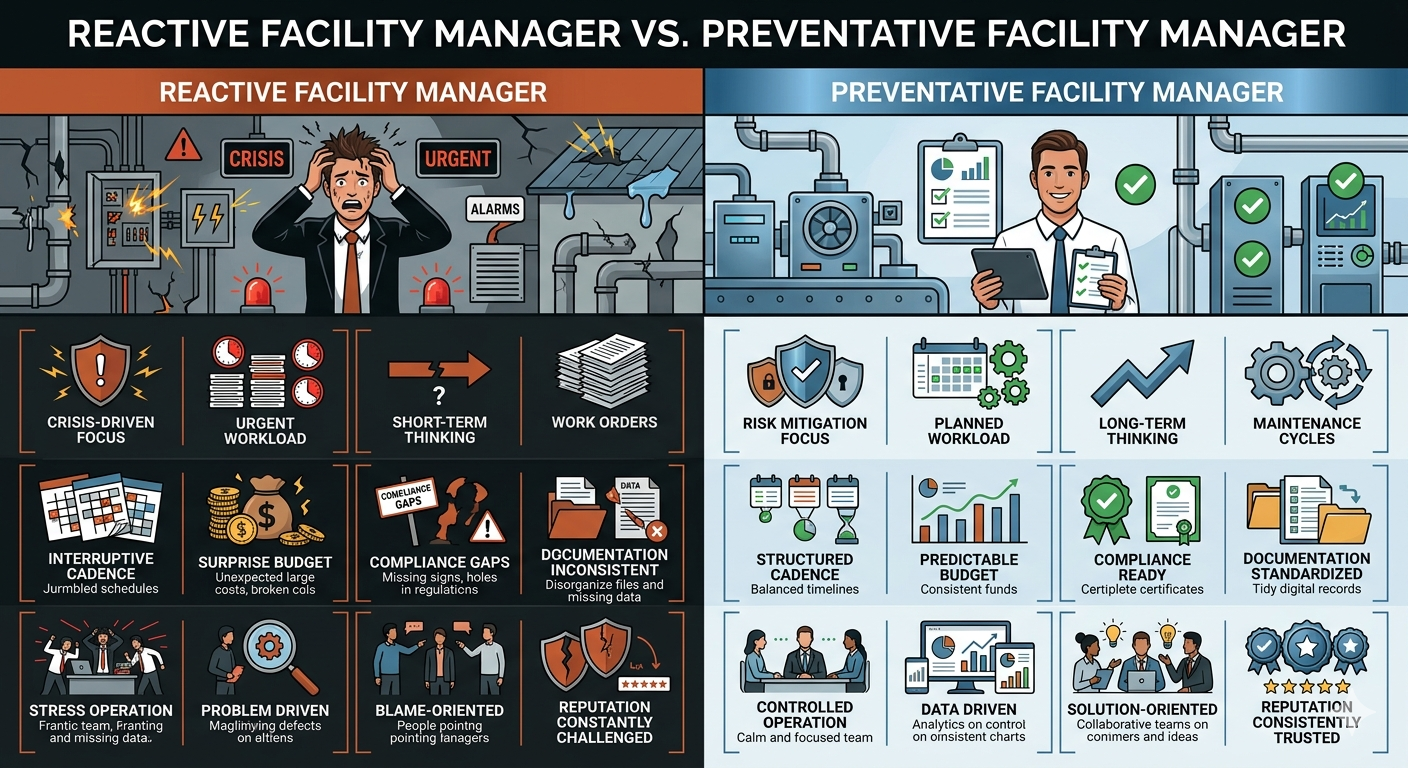
As told, “It’s easier said than done.” However, in my years of working with facility managers, I’ve noticed the perspective shift pays big dividends for the company and for the manager. Urgency is replaced with planning. Instead of looking down at your feet at today’s deadlines, the preventative manager spends his day planning with a more strategic, long term thinking. The preventative manager allows maintenance cycles to create a structured cadence with a predictable budget. When regulators come on site they are ready with standardized documentation. Operational stress is replaced with control as data the facility manager is not asking who made the mistake, but strengthening solutions. In the end, the recovery manager’s reputation is challenged as failures compile and stress continues to drive the recovery manager into interruption, surprises and more inconsistencies.
Gain support as a facility manager with your stormwater infrastructure. Visit these pages to get started:
From Compliance to Capital: How Smart Stormwater Auditing Unlocks Federal Funding for SC Manufacturers
In South Carolina manufacturing, stormwater management has long been viewed through the lens of "avoiding fines." However, there is a shift in stormwater compliance that goes beyond simple checklist to more specific outcome monitoring. Which means that as we move into 2026, the script has flipped. With the launch of the ISO 14001:2026 revision and a massive influx of federal "Green Infrastructure" grants, your Stormwater Pollution Prevention Plan (SWPPP) is no longer simply a regulatory burden; nor is meeting the SWPPP’s guideline the target. South Caroline manufacturing sites now see stormwater infrastructure as a valuable financial asset.
For facilities from the Upstate’s automotive corridor to the Lowcountry’s industrial hubs, the message is clear: Data is the new currency. Federal grant reviewers aren't just looking for "clean" sites. Instead, they engage with sites that can prove risk management through trend tracking.
The ISO 14001:2026 Shift: Climate Resilience & Biodiversity
The newly released ISO 14001:2026 standards place a unprecedented emphasis on Climate Change Adaptation and Life-Cycle Thinking.
In South Carolina, where extreme weather events and rapid industrialization put heavy pressure on watersheds, the new standard requires facilities to demonstrate how they are mitigating the risk of stormwater runoff before it leaves the property. Manufacturers must show a documented history of internal audits that track pollutant trends (like TSS, pH, or zinc levels). Manufacturers must show the data that effectively speaks the language of federal grant programs like the EPA’s Green Infrastructure Fund.
Your Audit Data is a "Grant Magnet"
When applying for Department of Energy (DOE) or EPA grants, "Project Readiness" is the highest-scoring category. By using your internal audits to show a three-year trend of reducing pollutants, you prove to the government that:
You have the administrative capacity to manage federal funds.
You have a baseline, making the "impact" of their grant money measurable and guaranteed.
Your risk management is proactive, reducing the chance of project failure.
Best Practices: Positioning Your Facility for Funding
Buck Outdoors Stormwater Solutions provides quarterly inspections & water monitoring
Many property investors and manufacturers want to transform stormwater program. The goal is to earn the reputation of “GREEN” conscious. They position themselves as a company the consumer wants to associate with and grant-ready. Implement these four high-impact actions today:
1. Leverage Third-Party Experts for Internal Audits
While your internal team knows the facility, a third-party auditor provides the "unbiased verification" that federal grant reviewers crave. An external audit identifies "blind spots" in your BMPs (Best Management Practices) and provides a professional report that carries significantly more weight in a grant application than an internal checklist. It signals to stakeholders that your data is ironclad.
2. Build a Bridge to Stormwater Specialists
Don’t wait for a site visit from DHEC (or the new SC Department of Environmental Services) to talk to an expert. Establishing an ongoing relationship with Stormwater Specialists allows you to stay ahead of regional watershed changes. These specialists can help you align your site’s specific runoff challenges with "shovel-ready" projects—like permeable pavement or bioswales—that are frequently targeted for South Carolina state incentives.
3. Install Water Monitoring Sondes
Monitoring water allows for 24/7 assessment of your facility’s discharge. State and federal regulators know that quarterly inspections provide a snapshot of your site for 4 days out the year. However, to really protect climate change, there must be constant monitoring. In today’s eco-system, you have a hard time convincing state and federal regulators that you embrace climate change correction without a monitoring system.
4. Use NPDES Inspections as Strategic Tools
Stop treating your NPDES (National Pollutant Discharge Elimination System) inspections as "pass/fail" tests. Instead, treat them as a data-gathering tool. Use your monthly or quarterly inspection logs to identify pollutant trends.
Strategic Tip: If your logs show a recurring spike in runoff during high-heat months, you can use that data to apply for "Heat Island Mitigation" or "Urban Cooling" grants through the South Carolina Energy Office.
The Bottom Line
South Carolina is entering a golden age of industrial green funding. By tightening your internal audit process and embracing the rigorous standards of ISO 14001:2026, you aren't just protecting the Palmetto State's water—you’re positioning your facility to lead the market.
Environmental Compliance Review: Regulatory Frameworks and Risk Mitigation Strategies
A recent incident (March 2026) in Fort Mill, SC has caused much commotion, leading to closure of an elementary school and the response by emergency vehicles after a call to 911. South Carolina’s Department of Environmental Service had already been on site to investigate a previous spill before the March 5 news headlines were created.
It is not my place to relay the story as a news report. Rather, the goal in this article is to highlight important facts for EHS directors, facility managers, and Operation Officers. I will highlight regulatory bodies, risk management plans, and environmental compliance.
The Multi-Tiered Regulatory Landscape: Federal, State, and Local Jurisdictions
Establishing a robust environmental compliance framework is a fundamental prerequisite for industrial operational continuity and the maintenance of a "license" to operate. For facilities in South Carolina, a clear understanding of jurisdictional boundaries prevents regulatory gaps and ensures institutional oversight is redundant and comprehensive. Navigating this multi-tiered landscape requires an integrated approach that respects the distinct roles of federal, state, and local authorities.
The South Carolina Department of Environmental Services (formerly DHEC) oversees the state’s regulations, possessing the authority to issue air quality permits, industrial pretreatment permits, and National Pollutant Discharge Elimination System (NPDES) coverage. While the U.S. Environmental Protection Agency (EPA) maintains federal oversight through the Risk Management Program (RMP), the EPA National Response Center (NRC) must be notified immediately of any chemical releases exceeding the "Reportable Quantity" (RQ). Local governing bodies, such as York County, manages land use, zoning, and the Municipal Separate Storm Sewer System (MS4) program. The local government lacks the legal authority to issue or enforce environmental permits.
These authorities converge during facility-level emergencies. While SCDES serves in an advisory capacity and may issue "directives to cease operations" following a release, the local fire department and emergency management serve as the on-scene incident command. These local entities are the primary decision-makers regarding tactical public safety measures, including school closures and evacuations.
Risk Management Plan (RMP) Requirements and Technical Framework
An RMP is a strategic tool for identifying off-site consequences of accidental releases and ensuring operational longevity through rigorous hazard mitigation. For manufacturing facilities, the RMP is the primary mechanism for validating safety protocols before hazardous materials are introduced to the site.
Based on the presence of regulated substances such as Silane (a flammable gas) and Hydrochloric Acid (HCl), facilities are mandated to submit an RMP to the EPA. It is a critical technical nuance that while industrial sites like Silfab Solar handles Hydrogen Fluoride (HF), it is not subject to RMP requirements for that specific substance because it is stored at a concentration of 49%, falling just below the 50% regulatory threshold. Mandatory RMP components include:
Off-site Consequence Analysis: Modeling "worst-case" and "realistic" release scenarios to determine potential community impacts.
Accident Prevention and Emergency Response Plan: Site-specific strategies addressing unique chemical inventories.
Employee Training: Rigorous instruction on chemical hazards and operating procedures for personnel handling regulated substances.
Annual Drills and Coordination: Mandatory yearly exercises performed with local emergency response agencies.
Coordinating these plans with local responders prior to bringing chemicals on-site is a strategic necessity. Proactive engagement ensures that incident command has the data required to determine if personal protective equipment (PPE) is necessary or if public notification is required, thereby mitigating the risk of community distrust following an incident.
Integrated Water Management: Stormwater and Wastewater Compliance
Stormwater prevention and wastewater management are critical to the ecological health of South Carolina’s watersheds. Compliance requires a dual-track approach satisfying local runoff mandates and state-level industrial discharge requirements.
The MS4 program, managed by York County, focuses on land disturbance and sediment control. In contrast, the Industrial Pretreatment and NPDES permits are managed by SCDES. As a "significant industrial user," a facility must pre-treat wastewater on-site before discharging into municipal systems, such as the City of Fort Mill’s. Crucially, the pretreatment system cannot be placed into operation until a final industrial discharge permit is issued by the City, and a registered engineer has certified that construction aligns with approved specifications.
A central requirement for water quality is the Best Management Practice (BMP) Plan, which must specify:
Identification of Spill Sources: A comprehensive list of all potential sources of leaks involving oils, hazardous, and toxic substances.
Methods of Containment: Physical and procedural barriers to prevent pollutant migration.
Training and Inspection: Schedules for personnel education and equipment security checks.
Emergency Response Measures: Protocols for addressing accidental discharges to surface waters.
Hazard Profile: Chemical Handling and Emergency Remediation

Manufacturing processes often involve corrosive materials that pose high-consequence risks to human health and material integrity. The following summarizes the hazard profiles for chemicals utilized in solar cell etching and texturing that Silfab reportedly spilled:
Chemical Property
Specific Hazards (Human/Material)
Neutralization/Cleaning Steps
Hydrofluoric Acid (HF)
HF is caustic and highly corrosive. It penetrates skin tissue to cause deep ulcers, and toxic fumes irritate lungs. Close contact to HF may cause life-threatening irregular heartbeats. When HF touches the skin, the area should be flushed with water for over15 mins. Once flushed apply magnesium or calcium solutions and seek immediate medical help for ECG monitoring or endoscopy.
Potassium Hydroxide (KOH)
KOH is an inorganic, highly corrosive solution. The compound readily reacts with various metallurgy causing material integrity failure. KOH is corrosive to all body tissues. When someone comes into contact KOH, they should immediate do a15-minute water flush of eyes/skin. In clinical settings, irrigation may need to continue for several days.
Remediation Protocol: In the event of exposure, immediate irrigation with water for at least 15 minutes is the priority. For HF, professional medical intervention is mandatory to monitor for systemic poisoning; activated charcoal is ineffective for acid poisoning. Clinical settings must utilize magnesium/calcium solutions to neutralize the acid and perform ECG monitoring to manage potential cardiac arrhythmias or blood pressure drops.
Spill Reporting Protocols and Disclosure Mandates
Transparency in reporting prevents regulatory "cease operations" orders. When a release exceeds the Reportable Quantity (RQ) and leaves the property, specific disclosure mandates are triggered.
Federal/State Notification: Immediate notification must be provided to the EPA National Response Center (NRC) and SCDES.
The 24-Hour "Upset" Rule: Under air permit conditions, any malfunction of air pollution control equipment (e.g., wet scrubbers) lasting more than one hour that results in emissions exceeding permit limits must be reported to SCDES within 24 hours.
Failure to adhere to these windows can lead to severe interventions. For example, following a Potassium Hydroxide (KOH) spill on March 3, 2026, and a subsequent Hydrofluoric acid (HF) leak just 48 hours later on March 5, 2026, SCDES issued a "directive to cease operations" to assess root causes and community risk.
Actionable Preparedness: 5 Strategic Steps for Manufacturing Sites
To transition from reactive crisis management to a proactive compliance culture, manufacturing sites should implement the following steps:

Execute Pre-operational Jurisdictional Coordination: Establish formal communication with local fire, EMS, and school district leadership before chemicals arrive. This ensures the RMP is a functional roadmap for local stakeholders. An overview of these steps should be included in the Stormwater Pollution Prevention Plan (SWPPP).
Implement Automated "Fail-Safe" Shutdown Protocols: Integrate automated systems that halt manufacturing if wet acid scrubbers fall outside established parameters for pH, liquid flow rate, and pressure drop.
Conduct Community and School-Inclusive Drills: Include nearby sensitive receptors, such as schools, like Flint Hill Elementary, in annual emergency exercises to build trust and prepare the "on-scene incident command."
Enforce Rigorous Third-Party Testing: Adhere to a strict testing schedule for air emissions and water discharge. These should be conducted by an independent firm and observed by state regulators. The air emissions should be completed within 45 days of reaching maximum production (or 180 days of start-up) and every two years thereafter. Water monitoring should be conducted every three years.
Standardize Enhanced SDS and BMP Training: Mandate Safety Data Sheet (SDS) and Best Management Practice (BMP) training for all personnel to ensure site-wide awareness of spill identification and containment.
Environmental compliance is not a static achievement but a continuous cycle of monitoring and engagement. SCDES will conduct unannounced inspections to verify that equipment, monitoring records, and reporting protocols remain in strict adherence to state and federal law.