WHAT IS A STORMWATER INSPECTION :
Understand that fulfilling local, state, and federal inspection requirements is not the same as property management. The regulatory inspections answers one question, is the infrastructure currently working as designed. I once sat in a class with a mix of regulators and consultants from around South Carolina. The facilitator showed an image of a stormwater pond. He said raise your hand if you think this pond is deficient. As some of the hands went up, mine included, the facilitator gave a satisfying grin and said, “That provided my point better than I thought.” He pointed out those who were not satisfied with the pond’s condition were all consultants. He turned to the seasoned regulator and asked, “Why would you pass this pond?”
The veteran, government regulator simply said, “It’s functioning, today.” The consultants argued that deferred maintenance would be costly to the property owner and that failure was imminent. The facilitator came to the regulator’s support explaining that inspections only ask if the stormwater infrastructure is functioning at the time of the inspection. None of the regulators in the room were interested in the risks.
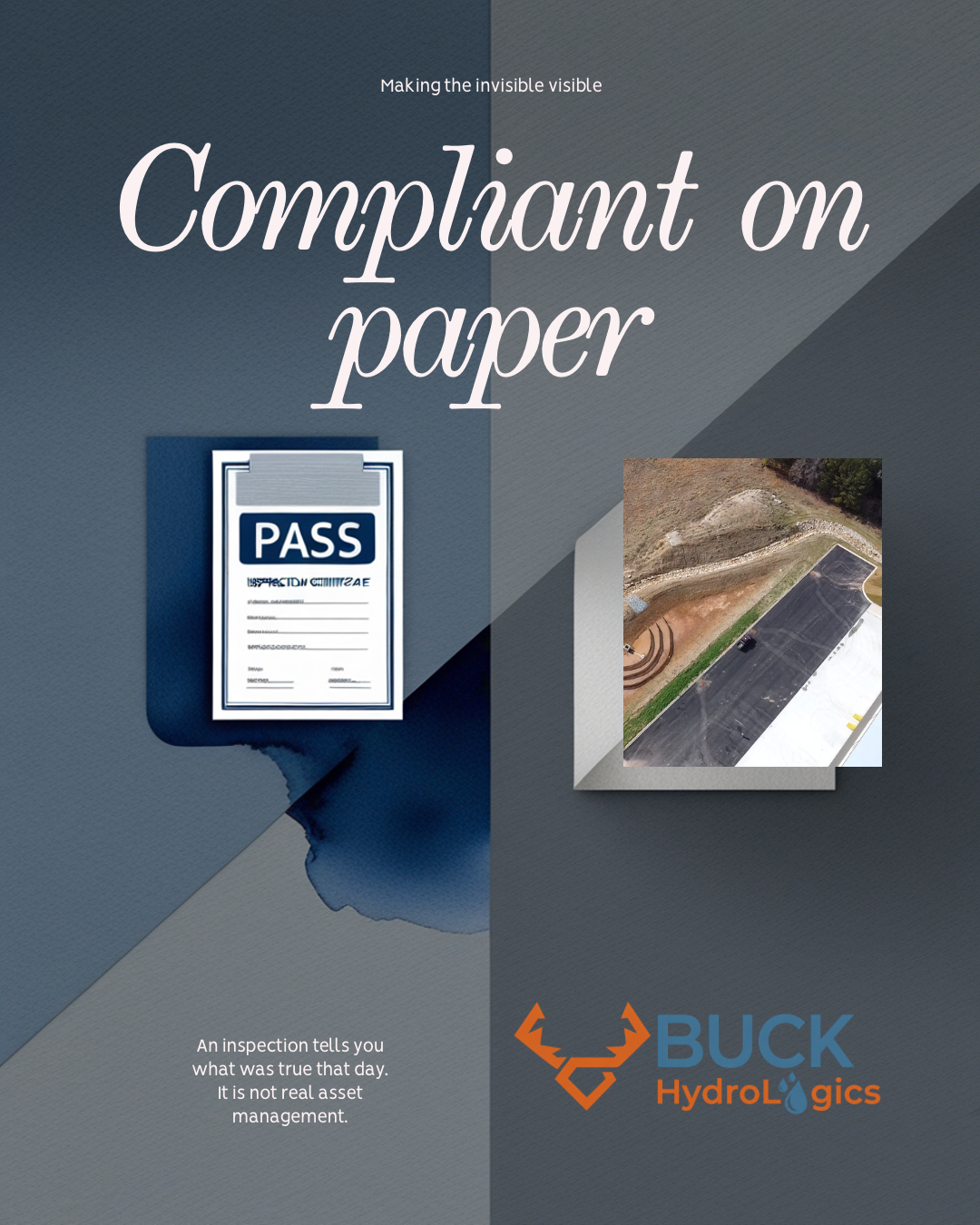
So what is an inspection? Historically, it merely evaluates the current functionality and environmental effect. The inspection does not worry about the CapEx budget and increasing cost of corrective action. To rely on regulatory inspections for decisions on stormwater infrastructure is to wait for problems to surface. The inspections do not evaluate risks and provide effective oversight for property managers.
WHO IS RESPONSIBLE FOR THE INSPECTIONS:
Regardless, the inspections must take place. South Carolina requires property owners to conduct annual inspections in the Stormwater Maintenance Agreement. These annual inspections can be completed with solely compliance in mind, which seems to be a wasted opportunity. However, when meeting this obligation, the property manager fulfills his role with an asset assessment. An in depth assessment goes beyond the current conditions. It provides CapEx data, corrective action tracking, and an overall health score for the facility.
While the inspection should be performed by a stormwater professional who is willing to assist with uncovering hidden risks, it is the property owner’s ultimate responsibility for having an inspection completed each year.
What about inspections from the state or county.
True, local and state regulators will conduct inspections. These generally take place once every five years, or so. However, during these audits, the regulator will often ask to see your inspections over the past several years. Even if your pond is functioning, the auditor will note any document gaps as a deficiency.
DOCUMENTS TO KEEP ON HAND:
There should be documentation of each inspection complete with time stamped photos. The old school method of tracking this documents is a three ring binder. However, many scenarios are wanting an electronic file or database. Especially when stored online, the regulator is able to look at these documents without stepping foot on your property.
Here is a list of items to keep in the file:
Records from all inspections with photo documentation: The photos defend the report and are to be geo & time stamped. Most regulators want to see at least three photos. We recommend focusing on the outfall, wide angle of the entire stormwater pond, vegetated swales, and catch basins.
As-Built plans: Do not assume that your local development office has these on hand. You should have a copy accessible as a benchmark for the inspections and these are required to have for most repairs to be completed on stormwater infrastructure.
Stormwater Pollutant Prevention Plan: Industrial sites are required to have these on hand as an operational document specifically written for the facility. However, we recommend a similar document on all commercial and multi-family residential sites. We refer to these documents often as a Sustainability Plan or Environmental Stewardship Committment.
Corrective Action Tracking: Though regulators are primarily concerned with current condition, to be able to show that you act in a timely manner to problems, often gives regulators the confidence that your property is being managed.
Learn more about Buck HydroLogics Management System for documentation storage.
WHEN SHOULD INSPECTIONS BE PERFORMED
Inspection rhythm by a stormwater professional is really site specific. We recommend that industrial sites should be randomly inspected once a quarter. This allows to track trends and build stronger confidence that the property is right for the tenants and that the tenants are good stewards of the property. Commercial property (offices, retail, and residential) can get by with two assessments per year. Beyond this, we recommend that property managers and facility managers make a visual after every major rain event. Have a checklist of 5 or 6 things to note as you perform a quick walk through. Your stormwater professional should be able to provide you with a list that is site specific.
TOP 3 VIOLATIONS WE SEE MOST OFTEN
Vegetation is at the heart of most violations. Overgrown vegetation and lack of density. One area that is often forgotten about when mown is the pipe between the discharge riser and outfall. Remember, the outfall is where the stormwater and potential pollutions leave your site and enter the watershed. If a regulator cannot get to the outfall pipe he cannot inspect your effect on the environment and is left to assume that you are not overseeing the effects.
Documentation gaps is another deficiency. Too often a site assumes that they do not have to record the activities on their property. They also do not know what needs to be documented. Regulators must see documents to defend the health of the stormwater. This same defensible documentation is used to protect property owners in legal disputes.
Failure to protect catch basins with the proper filter. There are several types of filters that can be inserted into stormwater catch basins. When protecting basins from floatables inside green infrastructure is different from using a filter in a parking lot that absorbs fuels and oil. Too often these filters are left alone or cut when full.
HOW PROACTIVE INSPECTIONS SAVE MONEY LONG TERM
As you consider inspections, you will fall short if you see them as a simple fulfillment of regulations. Inspections should be used to catch problems. As we interact with our clients, we initially give a pass or fail based on the functionality of the stormwater pond. However, we continue to the next level of helping the client prioritize restoration needs and budget for those repairs. Many of the repairs we can provide ourselves, but often we lead through the finding quotes and overseeing the project for the client.
Stay ahead of stormwater issues. We share practical stormwater insights, inspection reminders, and compliance tips written specifically for property managers. Join our mailing list to stay informed and reduce risk before problems arise.
If you’re a property manager responsible for stormwater compliance, Buck Outdoors LLC provides inspections and maintenance for residential, commercial, and industrial properties across the upstate of South Carolina. Feel free to contact us if you have questions about your site in Oconee, Pickens, Anderson, Greenville, Spartanburg, Cherokee, Laurens, or Greenwood counties.KEYWORDS: stormwater inspections for property managers, stormwater compliance, commercial stormwater inspections