
The best tool, you will use it everyday
Keeping your equipment properly greased is essential for its long life and to prevent breakdowns. Grease helps keep the moving parts of a machine running smoothly and it also prevents rusting, corrosion and wear. It is important to make sure that all skid steers, mowers, excavators and other machines are regularly serviced with greased in order to ensure their longevity. Oh, and here’s a life hack for you. Click here to Amazon, buy a tube of grease and place it on repetitive purchase. You shouldn’t need more than 1.33 tubes per equipment to grease each month.
Failure to maintain such equipment with grease can lead to costly repairs as well as potential hazards such as fires or serious injuries due to machine failure. Therefore, it is important for everyone involved in the use of heavy machinery and compact equipment, whether on a farm or in construction work, to regularly inspect and apply the necessary grease so that it continues functioning efficiently.
Many people apply too much grease to equipment. I was taught, like many others, that grease should be applied until it is seen coming out of the joints. However, the seals in those joints give out under extreme pressure. Often times these seals are difficult to get to and change out. Therefore, we recommend the equivalence of two squirts per daily application.
Time is a valuable resource and a precious commodity. Taking time out of the morning to grease equipment slows things down. What if I told you that I can cut your morning grease time by more than half. Saving you time means you either get more done in the day or cut down your daily hours. Imagine if you save five minutes a day. This is equivalent to nearly a whole week saved each year. Perhaps time saved in the morning routine frees you up personally to be more productive. Or frees your employee, meaning payroll becomes more productive.
Do the math, if you pay a laborer $15 per hour. Your 5 minutes a day saved for a year comes up to nearly $325. Meaning that using a battery operated grease gun pays for itself. DeWalt, Milwaukee, and Ryobi make excellent grease guns that can be purchased on Amazon. These guns coupled with a Lock’n Lube cut your grease time drastically.
We also recommend that greasing and other routine maintenance and non-scheduled repairs be documented in a log book. These records can prove to be helpful for equipment resell and insurance purposes.
How fine is material left when mulched?
Yesterday, a potential client asked me how fine the material would be after we completed a job in their neighborhood. She mentioned that the HOA board had watched one on my videos and were concerned that the finished project would be a gnarly mess. I responded, “That’s a fair question, and I respect the inquiry. However, the answer is as fine as you want it.” I explained that the video her neighbor’s watched showcased a different type of machine, leaving larger material. The hydro-ax that we typically use for her application is a CIMAF D180, as opposed to the Rutt Rotary mulcher she was seeing. With the CIMAF, I can work it as finely as she wants. The finer I go, the slower I must work.
Want to save money? We can get in and out, leaving behind larger debris, the size of an adult’s forearm. Need the property clean and stable? We can go back over the material multiple times, leaving a finer mulch that acts as a soil stabilizer, which is what most people prefer. Want the grounds to look like the removed trees never existed? We can go to the extreme and remove the debris, which will require a haul away fee as well as another step to stabilize the soil. To acquire soil stabilization in accordance with local regulation, require sod placement or seeding and straw.
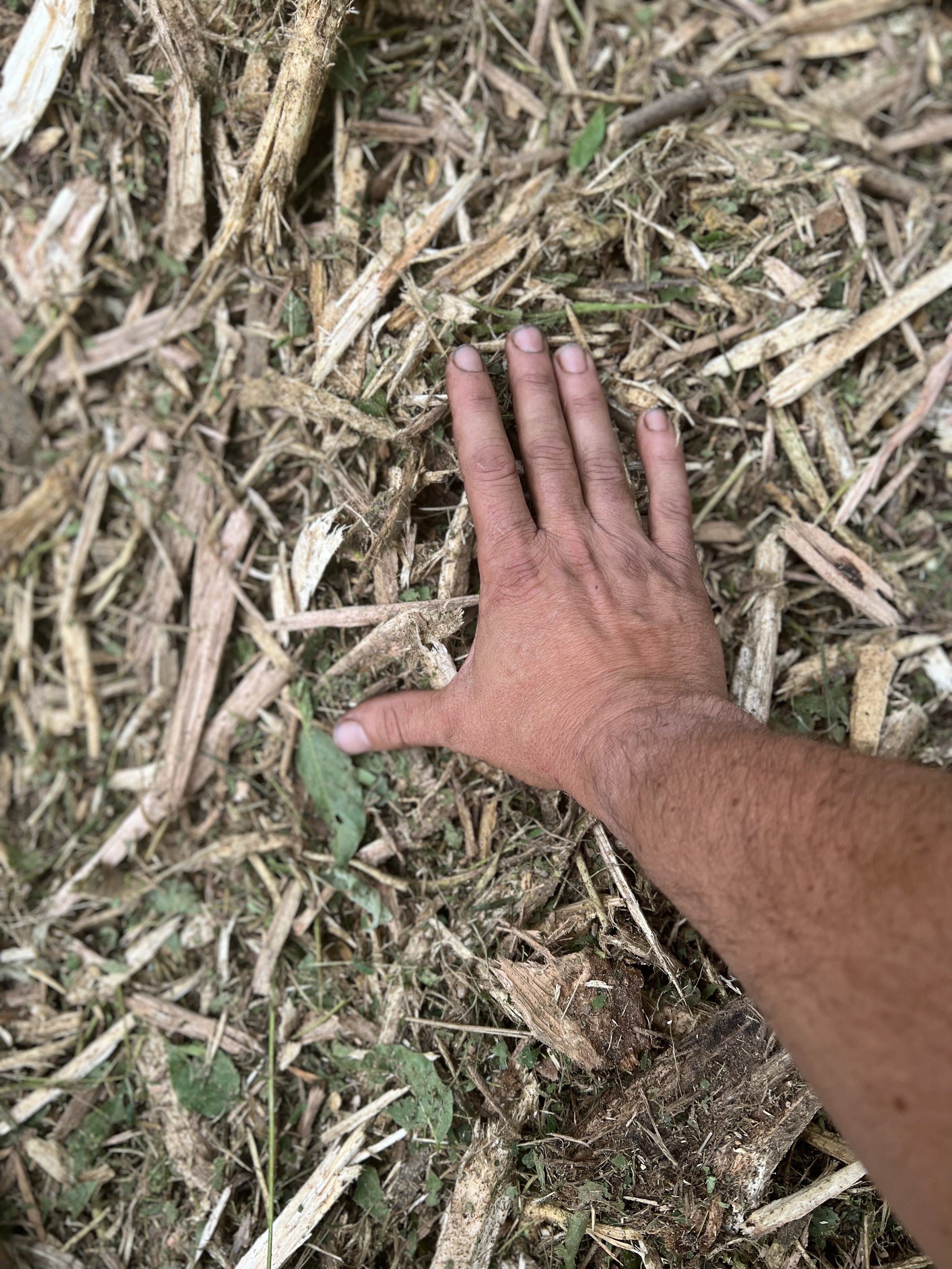
Debris left behind
is the size of a finger or two on a typical job. However, we can remove debris from the area if you have zero tolerance for remaining material.
Buck Outdoors will formulate a plan depending on your budget and tolerance levels. Inquire today, using our simple form.
Neglected Pond in Taylors, SC
When I answered the phone, I didn’t realize the mess the potential client had on her hands. “Mr. Buck, you’ve been working with a friend and they said you could point me in the right direction. Do you mow detention ponds?” I told her that we spend most of our time mowing detention ponds as we have over 350 ponds to mow each year. Then she unfolded a too common story about how her neighborhood did not even realize the pond was their responsibility. Regardless, they were looking down the barrel of a potential $30,000 fine if they didn’t do something about it quickly.
My son and I went out and looked at the pond. After about twenty minutes with an HOA member, we got back in the truck. My son said, “You don’t want this job.” I asked him to clarify his Sherlock conclusion.
He noticed that the first part of the conversation I would say, “We will…” However, as the time together went along, Jackson mentioned that I changed my wording to, “Whoever you hire needs to…”
Jackson was right. I didn’t want that job. Be that as it may, we won the bid and came to do the work. But not alone. I called a competitor and asked if he wanted to collaborate on a project. He was quick to respond, and together we got the job done safely and quickly. It pays off for everyone—me, my competition, and the client—when he view our competitors as cohorts in the industry.
Check out the video below to see how it went.
Three easy steps for HOA to be proactive with stormwater areas.
Too often, neighborhoods learn about stormwater management only because a problem arises. It’s understandable. However, with a few simple steps, HOAs can be proactive which saves time, frustration, and money. Oh, and being proactive with stormwater is best for the world we live in.

3 STEPS: HOA STORMWATER
Being proactive with stormwater is best for the world we live in.
(1) Being proactive with stormwater requires routine vegetation management. Routine management varies from pond to pond, but according to most state regulations means more than one. Such management, controls invasive weeds and prevents saplings from becoming large trees. Mature trees in stormwater ponds introduces extra debris, which increases the time for an expensive dredging . Furthermore, a fallen mature tree, does damage to the structure of the embankment and the pond’s floor. All samplings should be removed as soon as noticed within your pond.
(2) A proactive stormwater management also requires an annual inspection. Inspections should be performed by a certified post-construction inspector or a civil engineer. These inspections look for current failures in a pond, and perhaps even more important, they look for potential issues. Find issues early and addressing them generally enables the neighborhood to save money, or at least know how to plan for future expenditures.
(3) To be proactive in a neighborhood also requires home owner responsibility. The way homeowners manage their property greatly effects the neighborhood. Over watering a lawn sends more water through a pond as runoff from the yard enters the stormwater system. Also, over fertilized lawns send unabsorbed nutrients into the pond, over feeding vegetation causing weeds to thrive. Furthermore, not picking up pet waste, placing grass clippings and leaves in piles, vehicle oil leaks, washing cars on the driveway all add pollutants to your stormwater infrastructure.
Proper stormwater management requires each individual to be proactive. Gandhi remind us that our environment is not a gift from the past, but on loan from the future. We must do our part to keep stormwater runoff clean, because it saves time, frustration, and money, but even more importantly because it helps generations to come.
Stormwater; an economic resource
Stormwater is a big problem for cities—and a growing one. Lots of urban surface area is impermeable, so stormwater can’t sink into the ground but instead flows through the city. Meanwhile, climate change is altering and often intensifying rainfall and precipitation patterns.
Enter green infrastructure: natural areas that can capture, store, and filter stormwater, provide habitat and other benefits, and help cities comply with water quality laws and regulations.
Winter is a great time for detention pond management
Now that we’ve had a day of football, family and food, we start to turn our attention to the winter months—December, January & February. Well, after a long nap. Actually, these colder months are a great time to have your detention pond worked on.
During the colder months your detention pond is prime for working; if for no other reason, because it can be done at a lower cost. That’s right, you can save some hard earned cash by reaching out to a stormwater manager right now. “Why?” you ask. Here’s a short list of reasons:
1. Colder months often experience less precipitation.
2. Colder months, especially further north, has frozen ground. The solid ground makes for better working envrironment.
3. Colder months means vegetation has died off and is easier to cut. If your detention pond has Woody vegetation and briars, they are especially easier to cut.
4. Colder months means no snakes. Hey, it’s a factor.
5. Colder months are generally slower in the construction world, which means stormwater professionals are often looking for work and willing to do so for less money.
So, here’s the plan. As soon as you finish taking that nap, find a stormwater professional in your area and save some money.
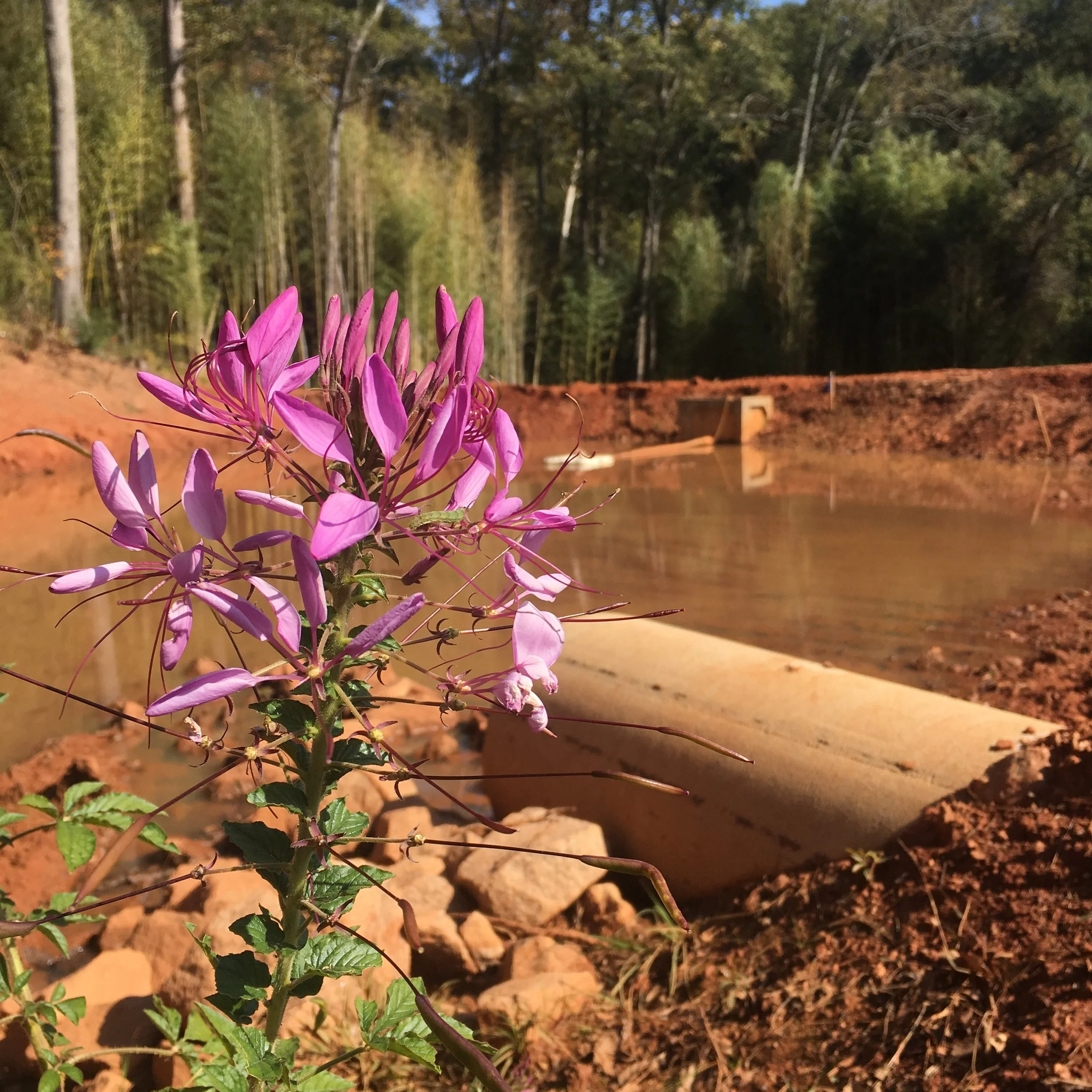
The Water You Drink
Did you realize that Greenville, SC has been recognized as having some of the best drinking water in the nation? Such quality water comes only from strict measures taken by municipality leaders to ensure water quality. Each day Greenville Water administers numerous water tests to maintain that quality (see Keeping the Greenville Drinking Supply Safe). But testing alone does not ensure water quality. It is essential that each community, home and individual recognize the role they play in water supply.
How can you effect your drinking water? Perhaps the greatest effect on our water quality is the stormwater that flows through your yard and into the community's streams. That’s right, the water we drink was once rain runoff, going through your yard. I know, this is something you were taught in grade school, the life cycle of Mr. Walter Drawp. See what I did there?
Unfortunately, our knowledge does not always connect with our behaviors. So, how do we live out the reality that the water flowing through our yard gets poured into our glass. For starters, don’t over fertilize, pick up pet wast, and wash your car at the car wash. Furthermore, your neighborhood has filtration systems for stormwater that prevents pollutants from getting into our water sources. Check with the place you work and your neighborhood to make sure a permanent stormwater manager is in place to set a stormwater pollutant prevention plan in action.
It’s very important that our community continues to value our water quality. Furthermore, keep in mind that the community is US—you and me. Each one of us must take individual responsibility for the role we play with our water sources.

What is the Permanent Stormwater System Maintenance Agreement
Buck Outdoors Stormwater Solutions offers the solution for landowners by preforming routine inspections and maintenance. Buck Outdoors crafts a plan that is suitable for the landowner to keep up their stormwater maintenance agreement.
Does the property you own or manage have a permanent stormwater system, such as a retention pond or detention pond? If so, having a better understanding of the Permanent Stormwater System Maintenance Agreement will save you future frustration and lots of money from fines.
In the 90s, South Carolina introduced the Stormwater Management and Sediment Reduction Act. Under this act, Regulation 72-308 requires that landowners, including home owner associations, be held accountable for "preventive maintenance on all completed stormwater management practices to ensure proper functioning." The act also mandates the local government to perform routine inspections on all aspects of the stormwater system, which includes but not limited to:
Vegatation
Fences
Spillways
Embankments
Reservoir area
Outlet channels
Underground drainage
Sediment load
To uphold this regulation, SCDHEC issues a Permanent Stormwater System Maintenance and Responsibility Agreement. This agreement states, "The Landowner, its successors and assigns, shall inspect the stormwater management/BMP facility regularly," and "perform the work necessary to keep these facilities in good working order as appropriate." In many instances, landowners neglect the inspection and maintenance of their stormwater systems. Furthermore, time and knowledge to uphold the agreement is also lacking.
Buck Outdoors Stormwater Solutions offers the solution for landowners by preforming routine inspections and maintenance. Buck Outdoors crafts a plan that is suitable for the landowner to keep up their stormwater maintenance agreement. By hiring a stormwater specialist, the landowner prevents a piece of property from becoming an eye sore and greatly lowers the risk of receiving a fine from the municipality, which is up to $1,000 per day per violation.
Contact Buck Outdoors Stormwater Solutions today to schedule a consultation.